Showing posts with label Canada. Show all posts
Button blankets are an important part of Pacific NorthWest Indigenous culture. 

In British Columbia classrooms, we endeavour to bring First Nations Principles of Learning into the daily life and culture of our classroom and school communities.

Learning about the artistry and significance of button blankets is one of the ways that we recognize and honour indigenous knowledge in our classroom.


Beautifully adorned blankets are worn as capes at ceremonial events. The crest on the back tells about the wearer's family. The blankets tell the story of people, places and events. They tell of the wearers position, roles and responsibilities in the community. They are a unique way of "learning and knowing" (Fine Arts, UVic).

They are powerful statements of identity. Yukon Museum

Over the holidays, I saw a button blanket doll tree ornament. Since it was well above my budget for sensory bin additions , and it looked pretty straightforward, I decided to make some myself.


As I was making these clothespin dolls, I was thinking that they made fine tree ornaments, but I wanted something that could stand up to add to my button blanket sensory bin and for small world play.

Peg dolls were the answer.


These are pretty straight forward to make - no need to be super crafty!

what you need
red felt (thicker, better quality felt is a good idea - having something with "weight" for the blanket works best
black felt (dollar store felt is fine for this)
black wool (for hair)
black acrylic paint (for "angel" style peg doll only)
sequins (I used iridescent - silver could work too)
good scissors
craft glue

two ways to make button blanket dolls


for a "giant" peg doll  - ordered from Stockade
1. Cut the dress out of black felt and the cape out of red felt.
2. Cut out decorative strips of felt for the dress and cape. I looked at the diameter of the sequins I was going to use, and determined the width from that.
3. Using craft glue, glue the decorative strips and sequins onto the dress and the cape. Allow a few minutes for the glue to dry.


4. Cover the peg doll's body with craft glue,
and attach the black dress.
5. Cut out  and glue on the crest for the back of the button blanket cape. Add sequins or "bling" where inspiration dictates.
6. Find the centre of the cape - put a thick line of glue down the centre of the cape  - attach to the back of the peg doll.
7. Put a good sized drop of glue on the inside top corners of the cape, and attach to the front of the doll.
8. Cut a number of 3 inch lengths of black wool for hair. Glue them onto the peg doll head. Glue wool onto the back of the head.
9. I would destroy the doll if I tried to add any facial features, so I didn't.

'

for an angel peg doll - ordered from Stockade
(I don't have step by step photos for this doll - but I am sure that you can extrapolate from the previous doll)
1. Paint the doll's body with acrylic black paint.
2. Glue on red trim and sequins.
3. Cut out red cape and black crest.
4. Glue black crest and sequins onto the cape with craft glue.
5. Find the centre of the cape - put a thick line of glue down the centre of the cape  - attach to the back of the peg doll.
6.  Put a good sized drop of glue on the inside top corners of the cape, and attach to the front of the doll.
7. Glue additional sequins onto the front of the cape as inspiration dictates.
8. Glue on wool hair.

Please click [here] or on the graphic for a free pattern printable. Remember, this is a starting point for your creativity.


The images are from School District 79's Aboriginal Education page on the school district website. They are available for anyone to use for educational purposes.

I chose the orca because it was the right shape for the blanket, and it looked manageable to cut out a small image. I have included the sizes that I used on the pattern page.

other button blanket resources


Secret of the Dance
author: Andrea Spalding
illustrator: Darlene Gait
Orca Book Publishers, 2006, 2009

summary: In 1935, a nine-year-old boy's family held a forbidden Potlatch in faraway Kingcome Inlet. Watl'kina slipped from his bed to bear witness. In the Big House masked figures danced by firelight to the beat of the drum. And there, he saw a figure he knew. Indigenous elder Alfred Scow and award-winning author Andrea Spalding collaborate to tell the story, to tell the secret of the dance. (Orca Books )

Orca Books has compiled some teacher resources.

I have "read the pictures" with my students, but I find the book is better suited to students grade 3 or older. 


Last year we did this project as part of our learning inspired by The 6 Cedars by Margot Landahl. I had cutouts of each of the animals from the book (wolf, raven, salmon, beaver, bear and orca), and the children were asked to chose the one that they felt represented their strength. 

button blanket sensory bin


We just loved Ted Harrison's paintings.  

They are so bright and cheerful (in fact, Harrison called his work "Cheery style") and are so distinctive - we figured that they were perfect for a kindergarten painting project. 


Emily Carr is a well loved West Coast Canadian artist.

When Emily Carr Met Woo
author: Monica Kulling
illustrator:  Dean Griffiths
published by Pajama Press (May, 2014)


A button blanket is a wool wearing blanket embellished with mother of pearl buttons created by Northwest Coastal tribes. - Wikipedia


We made button blankets (kindergarten style - no needles and thread). 


- so why not a button blanket sensory bin.  


It's summer time, beach time, swimming in the sea time.

A  perfect time for a under the sea sensory bin.


ingredients:
white sand
abalone shell pieces
dark blue aquarium gravel
coral fish tank accessory
ocean toob
blue plastic jewels
green glass gems
clear glass gems
shells
and large gems with First Nations drawings of sea creatures


I'm quite proud of these.  I shrunk some First Nations images (commissioned by my school district for use with students) and modge podged them to the back of large glass gems.  It adds a element of local culture to the bin.

As usual, the kidlets bring ideas to the bin that I had not thought of.


Creating underwater mountains with hidden treasure at the bottom seemed popular.


And finding that hidden treasure.


hoping that you find some time to feel the sand between your toes


Happy (almost) birthday Canada!

I was thinking about something specially Canadian to do with the kidlets to celebrate our country's birthday.


This year, I thought we would look to a Canadian symbol from the Arctic.  


The Inukshuk: a stone "pretend person" built on the tundra by the Inuit as hunting and navigational aids, markers and message centres.  

We looked at some inuksuit (plural of inukshuk) online, and then set to work to build our own.

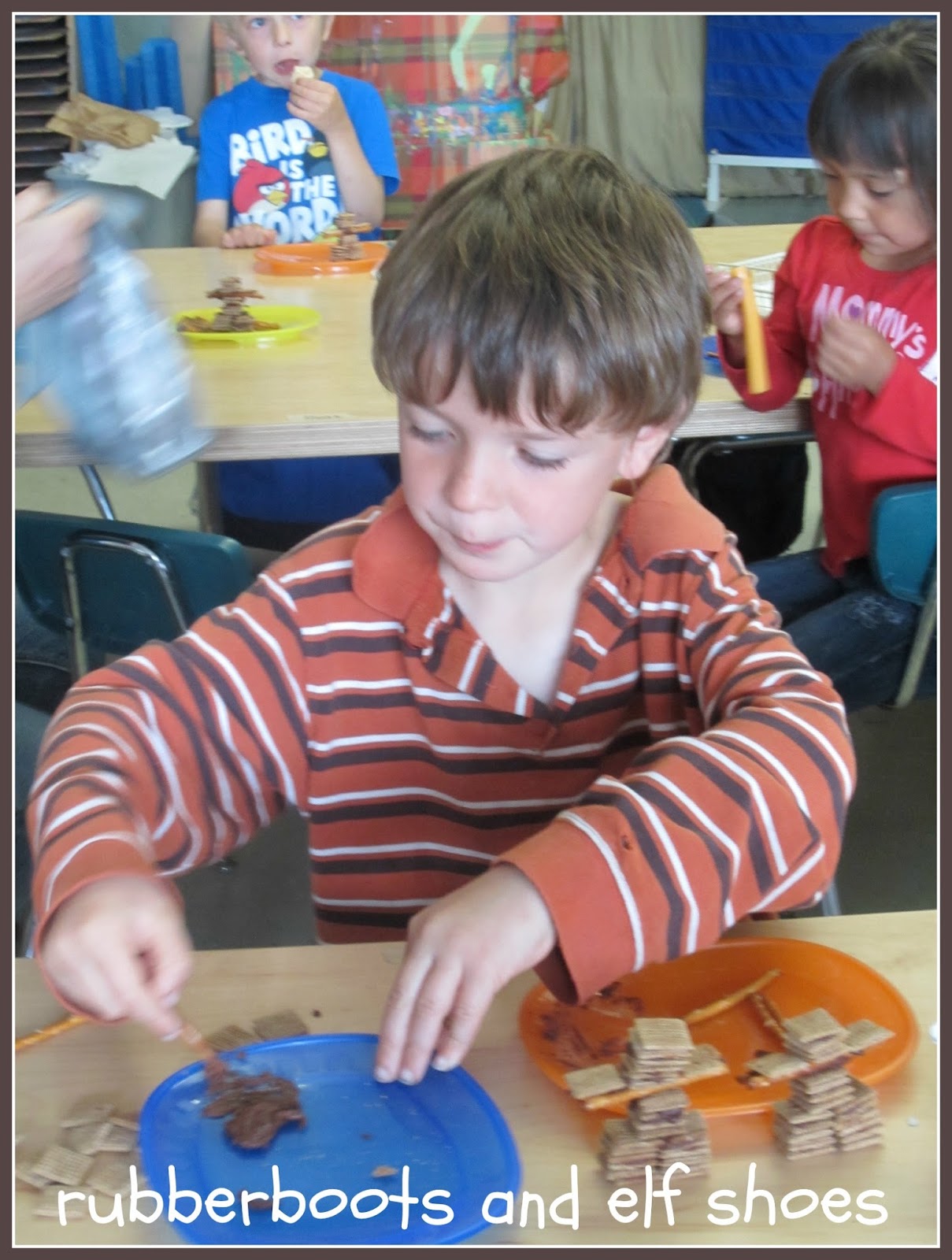
Twenty four Shreddies, 3 pretzel sticks and a blob of chocolate icing make one inukshuk. The instructions can be found on the back of a Shreddies box, or here.   

Six Shreddies "glued" together with icing for each leg.


Five Shreddies for the stone tummy.


Adding two pretzels for the arms and balancing Shreddies on top is delicate work.  But manageable. 

This inukshuk builder collected all the leftovers and kept building. 


The Shreddies inukshuks inspired some other classroom inuksuit.


Happy Birthday Canada!


Long, long ago, in a land far far away ...

Back in the late 1980s and early 1990s my husband and I lived and taught in Pond Inlet, Nunavut (it was still Northwest Territories then).


I drove a skidoo, 
 
 wore caribou clothing out on the land
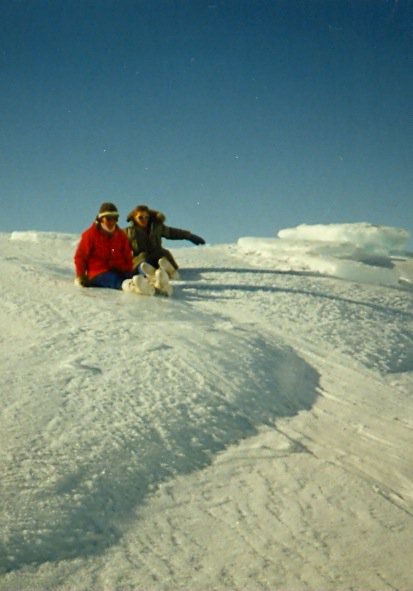
 slid down icebergs on skins
and found out how little I knew about teaching.

My five years (twenty-five years ago) on Baffin Island qualifies me (I guess) to be the Nunavut contributor for Reading With Miss D's party Booking Across Canada.  

I chose a book, written by a teacher who taught in a neighbouring Arctic community while we were in the Arctic. 


Out on the Ice in the Middle of the Bay
author: Peter Cumming
illustrator: Alice Priestly
publisher: Annick Press, 1993
theme: family, parent-child love, polar bears, Arctic life
age 4 - 7

opening lines
On a November afternoon, Leah's mother went visiting, leaving little Leah and her father to look after each other.  Leah's father told Leah not to go outside - there were polar bears nearby... Snow covered the land.  Ice covered the bay. The sun was starting to go down. The moon was coming up.  Out on the ice in the middle of the bay, a huge iceberg stood. 

summary
(from the back cover)
This is a story about 
the sun, which was going down,
the moon, which was coming up,
an iceberg, which was frozen,
      out on the ice in the middle of the bay,
a mother, who went visiting,
a father who was tired,
a polar bear cub, who was curious,
a polar bear mother, who was sleepy,
And Leah, a very little girl,
      who went outside to discover the world. 

why I love this book
Rereading Out on the Ice in the Middle of the Bay, I instantly go back to my Arctic days when I would "go visiting" (stopping by to visit with someone, walk in the door, no knocking, drink very strong tea with sugar), when the iceberg was a busy place in the spring time for "tea parties" (coleman stoves and tin mugs, not china and napkins) and when the roar of a snowmobile was normal.

Reminiscing aside - the story has a lovely balance-counterbalance in the stories of the dad and little Leah, and the polar bear and her cub.  We understand the love that each has for their child, and want the chance meeting of child and cub at the iceberg to end well for everyone.  

Alice Priestly's pencil drawings are perfect for creating the Northern atmosphere.  The human details are realistic - I saw many little girls look just like Leah in their Mother Hubbard parka, mitten strings included.  

resources
1. Enjoy the trailer for the book.
Blogger and YouTube do not seem to want to co-operate to post the video, so, please, click the link.  It's a beautiful trailer.


2. Work with a lesson plan.
Canadian Teacher Magazine featured a visualization lesson plan for Out on the Ice in the Middle of the Bay.

3. Learn about polar bears.
Kids National Geographic has their usual high quality, interest piquing multi-media information. 
World Wildlife Organization presents information about these fascinating creatures. 

4. Learn about Nunavut. 

5. Be artistic. 
That Artist Woman did this polar bear art project with a grade one class.  Stunning. 

6. Be crafty.
Little Leah wears a Mother Hubbard parka. (So did I - except when I went out on the land or was carrying my daughter).  Make a parka child with a body tracer and a parka made out of wallpaper samples or scrapbook paper, and a cupcake paper for the hood.

7. Enjoy some sensory play.  Make a winter bin and add some polar bears and other arctic animals.  Please, keep the penguins for the antarctic bin! Click on the graphic to go to the post. 

I am going to leave you with a picture that my husband took of me and our daughter just before we left Pond Inlet to move to balmy Vancouver Island.  We are helping the baby in the amautii move into a new house today.  I miss the time when my amautii hood was full. 


Back to Top